Plan Your Visit to Kyoto Railway Museum
Kyoto Railway Museum is a large, hands-on rail museum in Umekoji Park, best known for its full-size historic trains, preserved steam roundhouse, and interactive simulators. This is not a quick walk-through: the visit mixes indoor halls, outdoor rolling stock, timed shows, and paid add-ons that can reshape your day. The biggest difference between a rushed visit and a good one is whether you plan around the diorama, steam ride, and simulator early. This guide covers timing, tickets, route, and what to prioritise.
Quick overview: Kyoto Railway Museum at a glance
This is the section to read first if you want to avoid the two mistakes people make here most often: arriving too late for the timed extras, and underestimating how much there is to cover.
- When to visit: Thursday–Tuesday, 10am–5pm; weekday mornings in June or September feel much calmer than weekend late mornings, because school-holiday families and simulator lines build quickly after opening.
- Getting in: From ¥1,500 for standard entry, with Kyoto Railway Museum Tickets covering admission; simulator-inclusive options start higher when available, and advance booking matters most on weekends, Golden Week, and in August.
- How long to allow: 2–3 hours for most visitors, but it stretches closer to 4 hours if you add the steam ride, wait for the diorama show, or spend time inside multiple train cars.
- What most people miss: The Old Nijo Station building near the exit and the rail-view terrace upstairs both get skipped, even though they add context and one of the best vantage points in the museum.
- Is a guide worth it? Not usually for a casual visit, because the layout is manageable on your own, but rail enthusiasts who want deeper context may feel the lack of English interpretation more than families do.
🎟️ Tickets for Kyoto Railway Museum can tighten up a few days in advance during Golden Week, summer vacation, and major holiday weekends. Lock in your visit before the time you want is gone.
Jump to what you need
🕒 Where and when to go
🗓️ How much time do you need?
🎟️ Which ticket is right for you?
🚆 What to see
♿ Facilities and accessibility
Where and when to go
How do you get to Kyoto Railway Museum?
The museum sits in Umekoji Park, about 1.5km (0.9 miles) west of Kyoto Station and just steps from Umekoji-Kyotonishi Station, so public transit is the easiest way in.
Kyoto Railway Museum, Kankijicho, Shimogyo Ward, Kyoto, 600-8835, Japan
- Train: Umekoji-Kyotonishi Station (JR Sagano Line) → 2-minute walk → the entrance is directly across from the station.
- Bus: Kyoto Tetsudo Hakubutsukan-mae stop → 1-minute walk → Kyoto City Bus routes 17, 205, and 208 stop closest.
- Walk: Kyoto Station → 20-minute walk → easiest via the east side of Umekoji Park.
- Taxi / rideshare: Museum entrance on Kankijicho → direct drop-off by the park edge → useful with strollers or tight timing.
Which entrance should you use?
There is one main entrance, but the slowest part is usually whether you still need to sort tickets or timed add-ons once you arrive.
- Pre-booked admission: For visitors with tickets already sorted. Expect a 5–10-minute wait during busy weekend mornings.
- On-site ticket purchase: For same-day buyers using the machines or counter. Expect a 15–30-minute wait during holidays and school breaks.
When is Kyoto Railway Museum open?
- Thursday–Tuesday: 10am–5pm
- Wednesday: Closed, except on some national holidays
- Last entry: 4:30pm
When is it busiest: Saturdays, Sundays, Golden Week, Obon, and late-morning slots in spring and summer are the heaviest, when simulator demand rises and the indoor train halls feel much tighter.
When should you actually go?: Right at opening on a weekday gives you the best shot at the simulator, the quietest look at the Shinkansen cars, and more breathing room around the roundhouse.
How much time do you need?
| Visit type | Route | Duration | Walking distance | What you get |
|---|---|---|---|---|
Highlights only | Main rolling-stock hall → diorama → roundhouse → exit | 2 hrs | ~1.5 km | Covers the museum’s headline trains, the diorama, and the steam roundhouse, but skips most add-ons and slower stops upstairs. |
Balanced visit | Main hall → diorama → roundhouse → steam area → terrace → Old Nijo Station | 2.5–3 hrs | ~2 km | Adds the terrace, outdoor steam area, and quieter historic details, giving you a fuller sense of the museum without turning it into an all-day visit. |
Full exploration | Main hall → diorama → roundhouse → steam ride → simulators → terrace → Old Nijo Station → shop | 4 hrs | ~2.5 km | Lets you include the steam ride, simulator area, and time inside more train cars, but only works if you start early and keep an eye on queues. |
Which Kyoto Railway Museum ticket is best for you
| Ticket type | What's included | Best for | Price range |
|---|---|---|---|
Kyoto Railway Museum Tickets | Admission to Kyoto Railway Museum | A flexible museum visit where you want time for the train halls, locomotive displays, and interactive exhibitions at your own pace | From ¥1,500 |
How do you get around Kyoto Railway Museum?
How the museum is laid out
The museum is spread across a large indoor exhibition building and a substantial outdoor steam zone, so it feels more like a campus than a single gallery. It’s easy enough to navigate on your own, but timed shows and add-ons make a simple route matter more than people expect.
- Entrance promenade: Early headline stock, including the Shinkansen displays, and a strong first stop if you want photos before crowds build → 20–30 minutes.
- First floor main hall: Full-size rolling stock, hands-on railway exhibits, and the diorama theater → 45–60 minutes.
- Steam roundhouse zone: Turntable, preserved locomotives, workshop atmosphere, and the steam ride boarding area → 30–45 minutes.
- Second floor: Simulators, technical displays, and the restaurant terrace overlooking active rail lines → 30–45 minutes.
- Exit area: Old Nijo Station building, gift shop, and a calmer finish than most visitors expect → 15–20 minutes.
Suggested route: Start indoors with the first-floor displays and diorama timing, move outside to the roundhouse before midday, then finish upstairs so you naturally end near the terrace, restaurant, and Old Nijo Station instead of backtracking.
Maps and navigation tools
- Map: Printed entrance map → covers galleries, roundhouse, and key timed attractions → pick one up as soon as you enter.
- Signage: Good for major zones, but not enough on its own if you’re trying to catch the diorama, simulator, and steam ride in one visit.
- Audio guide / app: An official audioguide isn’t a major part of the visit, so self-guided visitors rely more on the map and on-site timing boards than on narration.
💡 Pro tip: Photograph the day’s show and add-on timings as soon as you enter — that one step saves the most backtracking later.
Where are the masterpieces inside Kyoto Railway Museum?

Steam locomotive roundhouse and turntable
Era / type: 1914 roundhouse with preserved steam locomotives
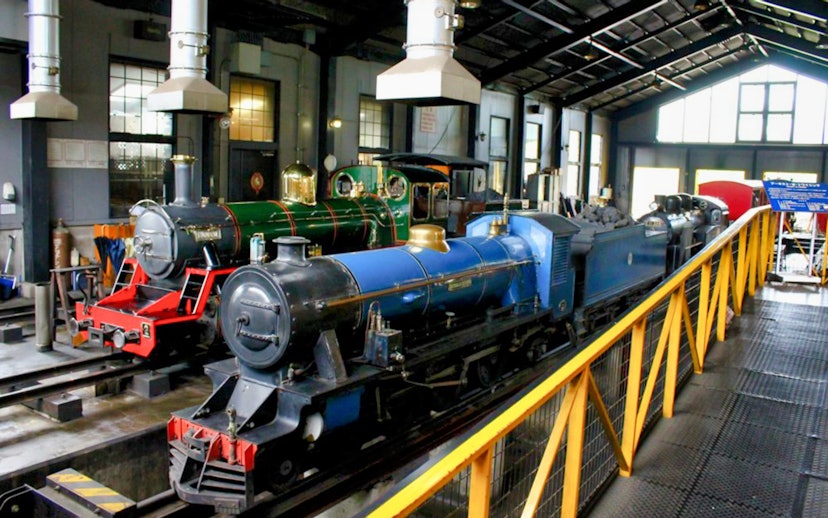
This is the emotional center of the museum: a huge semicircle of restored steam engines set around a working turntable. It’s worth slowing down here not just for the engines themselves, but for the scale of the building and the sense of how rail maintenance actually worked. What many visitors miss is the view back across the full semicircle from the upper observation bridge, which makes the layout far more impressive than it looks from ground level.
Where to find it: Outside the main museum building, beyond the first-floor galleries and near the steam ride platform
Steam locomotive ride
Era / type: Short heritage steam train experience
The ride is brief — about 10 minutes — but it adds something the static displays can’t: sound, motion, smoke, and the feel of a real working locomotive. Families love it, but enthusiasts enjoy it just as much because it turns the visit from observation into experience. What people rush past is the platform area itself, where the pre-departure atmosphere and engine prep are part of the fun.
Where to find it: Next to the roundhouse, at the steam ride boarding platform in the outdoor zone
Railway diorama show
Type: Large-scale operating model railway
This is one of the museum’s best family stops, and also one of its smartest. The show runs on a schedule rather than continuously, with multiple miniature trains moving through a detailed city-and-station landscape under changing lighting effects. What most visitors miss is that arriving even 5 minutes early makes a real difference, because the best front-facing views disappear first.
Where to find it: First floor, inside the main exhibition building at the diorama theater
0 Series Shinkansen
Era / type: Original 1964 bullet train
The 0 Series matters because it anchors the museum’s story of how Japan moved from steam heritage into high-speed rail. It’s easy to photograph quickly and move on, but it’s worth stepping inside to notice how different the interior feels from later high-speed trains. What many people skip is the chance to view it early in the visit, before lines build for interior access and cab photos.
Where to find it: Near the entrance-side exhibition promenade in the main museum area
500 Series Shinkansen
Era / type: High-speed bullet train, record-setting commercial service icon
This is one of the museum’s sleekest displays, and it lands differently once you’ve already seen the older stock. It’s not just another Shinkansen — it shows how dramatic the shift in speed, design, and engineering became. The detail most visitors miss is how good the contrast feels when you see it after the steam area rather than before it.
Where to find it: In the main train display area, close to the other signature full-size rolling stock
Train driving simulator
Type: Interactive driver-training-style simulator
This is the museum’s most competitive hands-on experience, and for good reason: it feels closer to a real operating cab than a standard museum game. If you get a slot, it adds genuine pace and focus to the visit. What many people miss is that the simulator shapes the rest of your route — if you book it late, you’ll spend the day watching the clock instead of settling into the exhibits.
Where to find it: Second floor, in the interactive experience area of the main building
Facilities and accessibility
- 🎫 Add-on counters: Steam ride tickets and some timed extras are handled separately from standard admission, so sort those early if they matter to you.
- 🚻 Restrooms: Restrooms are available inside the museum complex, and it’s smart to use them before joining any timed queue.
- 🍽️ Cafe / restaurant: The 2nd-floor restaurant serves light meals with rail-side views, but it’s more practical than destination dining and can feel crowded by mid-afternoon.
- 🛍️ Gift shop / merchandise: The museum shop sits near the exit and Old Nijo Station building, and it’s the easiest place to pick up railway-themed souvenirs without backtracking.
- 🪑 Seating / rest areas: The restaurant terrace and outdoor areas near the roundhouse are the best places to sit without leaving the museum flow.
- 🅿️ Parking: There is no dedicated museum parking lot, so arriving by train or bus is usually less stressful than driving.
- 🚂 Outdoor viewing areas: The roundhouse edge and observation points upstairs give you better sightlines than the ground-level crowd around the engines.
- 👶 Family pacing spaces: The broad outdoor areas near the steam zone are the easiest places to reset if children need a break from indoor exhibits.
- ♿ Mobility: The main visit combines modern indoor galleries with paved outdoor paths, but boarding certain historic train cars and cab displays can still involve steps.
- 👁️ Visual impairments: The strongest parts of the museum are its full-size trains, live movement, and large-format displays, while text-heavy interpretation can be harder to rely on if you want detailed context.
- 🧠 Cognitive and sensory needs: Weekday mornings are the calmest window, while the diorama shows, steam departures, and holiday afternoons are the loudest and most crowded parts of the day.
- 👨👩👧 Families and strollers: The wide galleries and outdoor spaces are much easier with a stroller than older heritage museums, though some train interiors are simpler to enjoy if one adult waits outside briefly.
- 🌤️ Outdoor sections: Part of the experience is outside around the roundhouse, so heat, rain, or winter cold affects comfort more than visitors expect from a museum visit.
- 🗣️ Language access: Basic navigation is manageable, but non-Japanese speakers may find that they get more from the large objects and interactive zones than from every interpretive panel.
Kyoto Railway Museum works well with children because it mixes full-size trains, movement, and hands-on experiences instead of asking them to stay patient through long text-heavy rooms.
- 🕐 Time: 2–3 hours is realistic with young children, but 3–4 hours is more comfortable if you want the diorama, steam ride, and a snack break.
- 🏠 Facilities: The open outdoor rail yard, upper-floor restaurant, and nearby park setting make it easier to reset between exhibits than at a more compact indoor museum.
- 💡 Engagement: Let kids choose one must-do early — usually the steam ride or simulator — so the rest of the museum feels like discovery instead of waiting.
- 🎒 Logistics: Arrive close to 10am, carry a light bag, and pack a small snack because the restaurant can get crowded and afternoon options thin out.
- 📍 After your visit: Kyoto Aquarium is close enough to pair on the same day if your group still has energy after the museum.
Rules and restrictions
What you need to know before you go
- Entry requirement: Standard admission is the core ticket, and timed extras like the simulator or steam ride should be planned separately instead of assumed to be included.
- Bag policy: A small day bag is easiest here because you’ll be moving through train interiors and between indoor and outdoor zones.
Not allowed
- 🚫 Food and drink: Keep meals and snacks to designated break areas rather than carrying them through the rolling-stock displays.
- 🖐️ Touching and climbing: Don’t climb into trains or handle equipment unless an exhibit is clearly marked interactive, because much of the stock is preserved heritage material.
Photography
Photography is part of the appeal here, especially around the full-size trains and the roundhouse, but the practical line is whether you are slowing other visitors down in narrow interiors or around timed interactive areas. Flash and large camera setups are best avoided inside busy train cars, and tripods or long photo stops can be disruptive where crowd flow is tight.
Good to know
- Timed extras: The steam ride and driving simulator are not automatically covered by standard admission, and both can shape your whole route if you plan them badly.
- Diorama timing: The model railway is much better treated as a scheduled stop than a casual pass-by, because the show runs at set times rather than continuously.
Practical tips
- Booking and arrival: Book Kyoto Railway Museum Tickets ahead if you’re visiting on a weekend, during Golden Week, or in August, and arrive near the 10am opening if you care about add-ons rather than just general entry.
- Pacing: Don’t spend your best energy entirely on the first Shinkansen displays; the steam roundhouse is the most rewarding section for many visitors, and it feels better before midday heat or crowding.
- Crowd management: Weekday mornings in June and September are the sweet spot here because you get quieter indoor galleries and shorter waits for popular interactive areas.
- Timed experiences: Treat the diorama as a fixed appointment, not something you’ll catch later, because missing one show can force you to rebuild the rest of your route around the next slot.
- What to bring or leave behind: Bring a light bag and a bottle of water, but leave bulky luggage at your hotel or station storage — stepping in and out of train cars is much easier without it.
- Food and drink: Eat early or late if you plan to use the 2nd-floor restaurant, since seats tighten by around 2pm and afternoon food choices are thinner than many visitors expect.
- Families: If you’re visiting with children, decide in advance whether the steam ride or simulator matters more, because trying to do both without a plan is where the day starts to feel rushed.
What else is worth visiting nearby?
Commonly paired: Kyoto Aquarium
Distance: About 650m — 8-minute walk
Why people combine them: Both sit in Umekoji Park, so this is the easiest same-day pairing in the area and works especially well for families or mixed-interest groups.
Commonly paired: Nishi Hongan-ji
Distance: About 800m — 10-minute walk
Why people combine them: It gives you a completely different pace after the museum — less interactive, more reflective — and fits naturally if you’re already heading back toward Kyoto Station on foot.
Also nearby
Kyoto Tower
Distance: About 1km — 15-minute walk
Worth knowing: It works better as a late-day add-on than a paired museum stop, especially if you want city views after a mostly indoor-and-yard visit.
Umekoji Park
Distance: Immediate surroundings — 1–2-minute walk
Worth knowing: This is the easiest reset space in the area, and it’s especially useful if children need outdoor time before or after the museum.
Eat, shop and stay near Kyoto Railway Museum
- On-site: The museum’s 2nd-floor restaurant serves light meals and drinks with a view of passing trains; it’s convenient and atmospheric, but more useful for timing than for a standout lunch.
- Kyoto Aquarium café area: 8-minute walk, Umekoji Park; handy if you’re pairing both attractions and want a simple mid-visit break without heading back toward the station.
- Kyoto Station restaurant floors: 20-minute walk, Kyoto Station; best choice if you want variety, a proper sit-down meal, or dinner after the museum.
- Kyoto Station convenience stores and quick eats: 20-minute walk, Kyoto Station area; best for a cheap, fast pre-visit snack if you want to maximize museum time.
- 💡 Pro tip: Eat before 12 noon or after 2pm if you plan to use the on-site restaurant, because the awkward middle window is when seating feels tightest for the least payoff.
- Museum gift shop: Railway-themed souvenirs, model trains, stationery, and child-friendly merch near the exit by the Old Nijo Station building.
- Kyoto Station shopping area: Better if you want to combine train-themed gifts with Kyoto snacks or city souvenirs instead of buying everything on-site.
This area is practical, but not the most atmospheric base in Kyoto. You can walk to the museum easily, and it suits travelers who want simple transit connections, but it feels more functional than charming once the park attractions close.
- Price point: The area skews practical and transport-friendly rather than boutique, with more choice opening up as you move back toward Kyoto Station.
- Best for: Visitors on a short trip who want easy access to the museum, Kyoto Station, and nearby family attractions without complicated transit.
- Consider instead: Kyoto Station for the widest hotel choice and easier dining, or Gion / Higashiyama if you want a more atmospheric Kyoto stay after your museum day.
Frequently asked questions about visiting Kyoto Railway Museum
Most visits take 2–3 hours. If you want the steam ride, the diorama show, a meal break, and time inside multiple train cars, 3–4 hours is more realistic. Rail fans can easily stay longer because the indoor galleries and the outdoor roundhouse feel like two separate halves of the experience.
No, you don’t always need to, but booking ahead is smart on weekends, national holidays, Golden Week, and in August. The museum can get crowded late in the morning, and pre-booking saves you from spending the first part of your visit sorting entry instead of getting inside.
Not really in the classic sense, because this isn’t a venue built around major fast-track tiers. The bigger time-saver is arriving early and pre-booking standard admission, especially if you also want timed extras like the simulator. Weekend bottlenecks usually come from crowding and add-on demand more than one giant entry queue.
Aim to arrive 10–15 minutes before the time you want to start exploring, and closer to opening if the simulator or steam ride matters to you. General admission is straightforward, but the best morning rhythm disappears quickly once families and holiday visitors start lining up for timed experiences.
Yes, a small bag or backpack is the easiest option here. Large luggage is awkward because you’ll be moving through train interiors, around outdoor displays, and up to the second-floor areas. If you’re carrying suitcases, it’s much better to leave them at your hotel or at station storage first.
Yes, photography is part of the appeal for most visitors. The main caution is practical rather than artistic: narrow train interiors and interactive areas get congested fast, so large setups, flash, and long photo stops can slow everyone else down. If you want cleaner photos, weekday mornings are your best window.
Yes, groups can visit, but they move more smoothly if they agree on priorities before entering. The museum is large enough to spread out, but timed elements like the diorama, steam ride, and simulator make it easy for a group to lose time waiting for one another if nobody sets a route first.
Yes, it’s one of Kyoto’s better family-friendly museums. Children usually connect quickly with the full-size trains, the diorama show, and the steam activity outdoors, even if they don’t care about railway history. Most families should plan on at least 2–3 hours, and more if they’re aiming for a hands-on experience.
Partly, yes — the main museum is modern and easier to navigate than many older heritage sites, but some historic train interiors and cab access points can still involve steps. The indoor galleries and paved outdoor areas are the easiest sections, while the preserved rolling stock itself is where accessibility becomes more variable.
Yes, there is on-site food, and you also have easy options nearby. The museum restaurant on the second floor is the most convenient choice, but many visitors prefer to eat before or after at Kyoto Station because the range is much better and the on-site seating can feel tight by mid-afternoon.
Yes, you should assume they are separate from standard admission. The steam ride is a small paid add-on on-site, while simulator access is limited and can sell out earlier in the day. If one of those is a must-do for you, build your whole arrival time around it.
The best time is right at 10am on a weekday outside school holidays. That timing gives you the calmest galleries, shorter waits to enter train cars, and the best chance of fitting in the add-ons before the middle of the day gets busy.