Kyoto Aquarium visitor guide for planning
Kyoto Aquarium is a compact inland aquarium best known for its giant Japanese salamanders, jellyfish gallery, and daily dolphin and penguin programs. It’s easy to cover in 2–3 hours, but the visit feels much better if you plan around feeding times instead of drifting room to room. Crowds usually stay manageable, though the dolphin stadium and main tank spike quickly around scheduled programs. This guide helps you time your visit, choose the right ticket, and move through the aquarium without doubling back.
Quick overview: Kyoto Aquarium at a glance
Kyoto Aquarium works best when you treat it as a timed indoor itinerary, not a drop-in stop between temples.
- When to visit: Weekdays are usually calmer than weekends and holidays. Late morning right after opening feels noticeably easier than the hour before the 1pm penguin feeding and afternoon dolphin programs, when families cluster around show spaces.
- Getting in: From ¥2,400 for standard entry. Annual passports start at ¥5,300, and booking ahead matters most on weekends, public holidays, and school-break dates.
- How long to allow: 2–3 hours for most visitors. It stretches closer to 3 hours if you time your route around the main tank feeding, penguin feeding, and a dolphin show.
- What most people miss: The Kyoto River habitat and Satoyama area get less attention than the dolphin stadium, even though the giant salamander is one of the aquarium’s most distinctive animals.
- Is a guide worth it? Usually no — the aquarium is compact enough to self-guide, but a guided visit adds more value if you want deeper conservation context or you’re visiting with older kids who’ll engage with the presentations.
Jump to what you need
🕒 Where and when to go
🗓️ How much time do you need?
🎟️ Which ticket is right for you?
🗺️ Getting around
🐧 Which animals to prioritize
♿ Facilities and accessibility
Where and when to go
How do you get to Kyoto Aquarium?
Address: 35-1 Kankijicho, Shimogyo-ku, Kyoto
- Walk: Kyoto Station → 15-min walk → Simple no-transfer route.
- JR train: Umekoji-Kyotonishi Station → 7-min walk → Fastest rail option from Kyoto Station.
- Bus: Kyoto City Bus #205/#208 → Nanajo Omiya / KYOTO AQUARIUM stop → About 8 mins.
- Taxi: Kyoto Station → 5–6 mins → Easiest with strollers or rain.
- Parking: No dedicated parking → Nearby paid lots available → Public transit is usually easier.
Which entrance should you use?
Kyoto Aquarium is straightforward to enter because there is one main entrance, but the mistake most visitors make is arriving just before a feeding or dolphin program and assuming they’ll still get a good viewing spot.
- Main entrance: Located inside Umekoji Park. Best for all ticket holders, but the ticket counter slows down fastest right after opening and before popular programs.
When is Kyoto Aquarium open?
- Daily: Opening hours vary by date, so check the operating calendar before you go.
- Last entry: About 1 hour before closing.
When is it busiest? Weekends, public holidays, March–April, August, and October–November feel busiest, especially from late morning into mid-afternoon when families line up their visit around shows and feedings.
When should you actually go? Go soon after opening on a weekday if you want quieter salamander and jellyfish viewing before the crowd gathers around the penguins and dolphin stadium.
How much time do you need?
| Visit type | Route | Duration | Walking distance | What you get |
|---|---|---|---|---|
Highlights only | Entrance → Kyoto Sea → penguins → jellyfish → dolphin stadium → exit | 1–1.5 hrs | 1 km | Covers the main exhibits and dolphin show quickly. Ideal between Kyoto Station plans, but you may miss quieter zones and feeding sessions. |
Balanced visit | Entrance → Kyoto River → Kyoto Sea → jellyfish → penguins → otters/seals → dolphin stadium → café → exit | 2–3 hrs | 1.5 km | The best overall pace for most visitors. You get the signature exhibits plus enough time to enjoy feeding sessions, photography, and quieter viewing areas without rushing. |
Full exploration | Full aquarium route with presentations, feeding times, café break, gift shop, and repeat viewing zones | 3–4 hrs | 2 km | Best for slower exploration, photography, and families, with time for presentations and exhibits like Jellyfish Wonder. Younger kids may tire by the end. |
How do you get around Kyoto Aquarium?
Layout and suggested route
- Kyoto River: Giant salamanders, trout, and koi → allow 10–15 mins.
- Kyoto Sea: Main tank with rays and reef fish → allow 15–20 mins.
- Penguin area: Land and underwater penguin views → allow 10–15 mins.
- Jellyfish Wonder: Immersive jellyfish gallery → allow 10 mins.
- Otters, seals & sea lions: Best near feeding times → allow 10–15 mins.
- Dolphin stadium: Live dolphin program and largest seating area → allow 20–30 mins.
Suggested route: Start with the Kyoto River and quieter indoor zones, then continue to the Kyoto Sea, jellyfish, penguins, and finish at the dolphin stadium to avoid peak crowds early.
Maps and navigation tools
- Map: On-site visitor map and daily program information → covers major zones and presentations → pick it up as you enter.
- Signage: Good enough for a self-guided visit → the route is short and clear → you usually won’t need anything more detailed.
- Audio guide / app: The aquarium experience leans more on live programs than app-based interpretation → check the daily schedule first because that shapes the visit more than an audio layer.
💡 Pro tip: Build your route around 1 or 2 timed programs, not every exhibit in order — the aquarium is small enough that feeding times, not walking distance, are what decide whether the visit feels smooth.
Which animals and habitats should you prioritize?

Japanese giant salamander
Species: Japanese giant salamander
Kyoto Aquarium’s most distinctive resident is this huge amphibian, displayed in a Kyoto River habitat that feels very different from a typical tropical aquarium tank. It’s worth slowing down because this is one of the few animals here that is genuinely tied to Kyoto’s local waterways. Most visitors glance once and move on, but the stillness is the point — look carefully along the rocks and edges for its full shape.
Where to find it: In the Kyoto River zone near the start of the route.
Jellyfish Wonder
Habitat: Jellyfish gallery
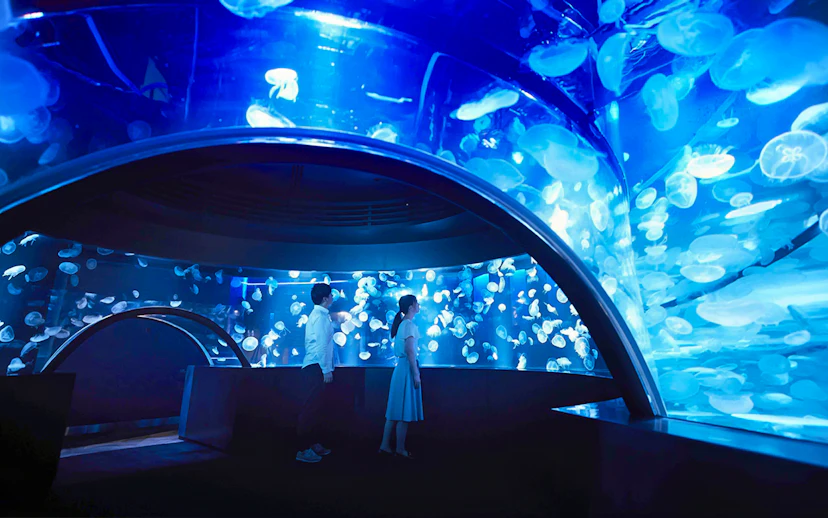
This is the aquarium’s most atmospheric space, with dim lighting and tanks designed for lingering rather than quick photos. It feels quieter and more immersive than the louder family zones, which is exactly why it rewards a slower stop. Most visitors spend less than 2 minutes here, but the shapes and movement become far more striking if you wait for a full drift cycle.
Where to find it: In the indoor jellyfish gallery deeper into the route after the larger habitat zones.
Cape penguins
Species: African Cape penguin
The penguin habitat is one of the aquarium’s liveliest spaces because you can watch the birds both waddling above ground and cutting through the water underwater. It’s especially good for children because the movement is constant and easy to follow. Most visitors only watch from 1 viewing angle, but the underwater section is where their speed and agility stand out most clearly.
Where to find it: In the penguin exhibit with both land-level and underwater viewing areas.
Kyoto Sea main tank
Habitat: Large saltwater tank
This 500-ton tank is the aquarium’s anchor exhibit, spread across the first and second floors with multiple viewing angles. It’s the best place to pause if you want scale, schooling fish movement, and a broader marine feel after the more local freshwater zones. Most people stay on the first viewing window, but the upper-level perspective helps you understand the full tank much better.
Where to find it: In the Kyoto Sea zone across the 2-level main tank viewing area.
Dolphin stadium
Experience type: Live animal presentation
The dolphin program is still one of the aquarium’s biggest crowd draws, and it changes the rhythm of the whole visit because many people organize their route around showtimes. It’s worth doing if you want an active, seated break after the galleries. Most visitors arrive too late and end up with poor sightlines, so the real priority here is timing, not just attendance.
Where to find it: In the dedicated dolphin stadium area.
Seals and sea lions
Species: Spotted seals and South American sea lions
These pools are easy to underestimate because they sit outside the aquarium’s headline zones, but they’re one of the most fun stops when the animals are active. Low viewing windows make this a strong section for children and close-up expressions. Most visitors pass through too quickly unless they time it around feeding, when the animals become much more animated.
Where to find it: On the first floor in the marine mammal area near the later part of the route.
Facilities and accessibility
- 🎟️ Tickets: Online advance tickets and on-site ticketing are both available, which helps if you want flexibility on a weekday but less waiting on a busier day.
- 🍽️ Café / restaurant: Food is available on-site, but visitors often describe it as expensive and more of a convenience stop than a destination meal.
- 🛍️ Gift shop / merchandise: Souvenir shopping is part of the visit, and reviews suggest the range is fun for children even if prices run high.
- 🅿️ Parking: There is no dedicated on-site parking, so drivers need to use nearby paid lots instead.
- 🩺 Indoor comfort: The aquarium is fully indoors, which makes it a practical rainy-day or hot-weather stop in Kyoto.
- 👨👩👧 Family layout: The route is compact, sightlines are easy, and the overall setup works well for strollers and shorter attention spans.
- ♿ Mobility: Kyoto Aquarium is wheelchair-accessible and fully indoors, with elevators and ramps that make it easier to move between floors.
- ♿ Mobility: The compact layout is a real advantage here because you can cover the major exhibits without long distances or steep transitions.
- 🧠 Cognitive and sensory needs: The jellyfish gallery is the calmest space, while the dolphin stadium and feeding areas are usually the loudest and most crowded.
- 👨👩👧 Families and strollers: The aquarium is one of Kyoto’s easier family attractions to navigate because the route is short, weather-proof, and not physically demanding.
- 👨👩👧 Families and strollers: If you’re visiting with a stroller, public transit or a taxi is easier than driving because there is no dedicated on-site parking.
Kyoto Aquarium suits children well because the route is short, the animals are easy to spot, and the mix of penguins, seals, jellyfish, and dolphin programs keeps the visit moving.
- 🕐 Time: 2 hours is realistic with young children if you focus on penguins, jellyfish, the main tank, and 1 live program.
- 🏠 Facilities: The biggest family advantage is the compact indoor layout, which means fewer long walks and an easy exit if energy drops.
- 💡 Engagement: Use the feeding schedule as your framework because children stay more engaged when each stop has a clear ‘next thing’ to look forward to.
- 🎒 Logistics: Bring a small bag, arrive before your chosen program, and skip driving if possible because parking adds friction without saving much time.
- 📍 After your visit: Kyoto Railway Museum is the easiest child-friendly follow-up because it sits right next door inside the same wider park area.
Rules and restrictions
What you need to know before you go
- Entry: Standard tickets are date-based; student tickets may require valid ID.
- Booking: Online booking is faster on weekends and holidays.
- Bags: Travel light; outside food is not allowed inside.
- Re-entry: No re-entry permitted once you exit the aquarium.
- Dress: Comfortable shoes help if combining the visit with Umekoji Park or the Railway Museum.
Not allowed
- 🚫 Food and drink: Outside food is not allowed inside the aquarium.
- 🐾 Pets: Pets are not allowed inside the aquarium.
- 🖐️ Exhibit behavior: Keep hands off glass and habitats so everyone can see clearly and the animals aren’t stressed during busy periods.
Photography
Casual photography is part of how many visitors experience Kyoto Aquarium, especially in the jellyfish, penguin, and main tank areas. The safest approach is to keep flash off in darker galleries, avoid blocking viewing windows during feeding times, and check any posted restrictions around live programs or special exhibits before shooting.
Good to know
- Language: Dolphin and other live presentations are conducted primarily in Japanese, so the visual action matters more than the narration for most international visitors.
- Timing: Last admission is about 1 hour before closing, which matters because a late arrival can cut the visit down to a rushed highlights loop.
Practical tips
- Booking and arrival: Book ahead for weekends, public holidays, and school-break dates, then arrive at least 15 minutes before entry and 30 minutes before any dolphin program you care about.
- Pacing: Do the Kyoto River and jellyfish rooms before the stadium-style programs, because those quieter exhibits are easier to appreciate before the route fills up.
- Crowd management: Weekday mornings work best here because the aquarium is small enough that 1 popular feeding or dolphin slot can change the feel of multiple nearby zones.
- Schedule strategy: If you want the most efficient route, line up the 12:30pm main tank feeding, the 1pm penguin feeding, and either the 2:15pm or 3:45pm seal program instead of trying to catch everything.
- What to bring or leave behind: Bring only a small day bag and your ticket confirmation, and skip driving unless you need it because there is no dedicated on-site parking.
- Food and drink: Eat before you enter or plan lunch after the visit, because outside food is not allowed and the on-site food is best treated as a convenience fallback, not the highlight of the day.
- Rainy-day planning: Keep this in reserve for bad weather, because the fully indoor layout makes it one of Kyoto’s easier wet-day attractions without needing a big time commitment.
What else is worth visiting nearby?
Commonly paired: Kyoto Railway Museum
Distance: About 5–7 min walk
Why people combine them: It’s the easiest same-day pairing in Umekoji Park, and together they turn a short aquarium visit into a fuller half-day with almost no extra logistics.
Commonly paired: Kyoto Tower
Distance: About 15 min walk
Why people combine them: It fits naturally before or after the aquarium if you’re already based near Kyoto Station and want 1 more easy indoor attraction without adding a long transfer.
Also nearby
- Umekoji Steam Locomotive Museum: About 3–5 mins away on foot; an easy add-on in the same park area after the aquarium.
- Nishiki Market: Best reached via Kyoto Station; a better follow-up for Kyoto street food and local snacks after your visit.
Eat, shop and stay near Kyoto Aquarium
- On-site: Kyoto Aquarium’s food options are convenient for a quick stop, but they’re better as a fallback than a planned meal because visitors often find them pricey for what you get.
- Kyoto Station dining: 15-min walk, Kyoto Station area; best all-around option if you want variety, easier value, and somewhere reliable before or after the aquarium.
- Umekoji Park cafés: 5–10 min walk, Umekoji Park; the easiest nearby stop for coffee or a light reset if you want to stay close and avoid station crowds.
- Nishiki Market: Bus or taxi via central Kyoto; better for a more local food-focused stop once you’re done with family attractions and ready to shift back into city sightseeing.
- 💡 Pro tip: Eat before you enter if you’re aiming for the 12:30pm and 1pm feeding slots back-to-back, because leaving the aquarium later for lunch ends the visit anyway.
- Kyoto Aquarium shop: Best for penguin, salamander, and aquarium-themed souvenirs if you want a child-friendly memento tied directly to the visit.
- Kyoto Station shopping: Better for a broader souvenir run because you’ll get snacks, gifts, and travel basics in 1 stop without aquarium-level pricing.
Staying near Kyoto Aquarium makes sense if you want easy access to the station and a practical base, rather than a romantic Kyoto neighborhood atmosphere. It works best for short stays, early train departures, and low-friction sightseeing days.
- Price point: The area usually skews mid-range to business-hotel practical, with the widest choice around Kyoto Station.
- Best for: Visitors on a short Kyoto trip, families who want simple transit, and anyone pairing the aquarium with station-area attractions.
- Consider instead: Gion or central Kyoto if you want a more atmospheric base, or Arashiyama if you’re planning a slower, nature-focused stay away from the station zone.
Frequently asked questions about visiting Kyoto Aquarium
Most visits take 2–3 hours. That’s enough time to see every major zone and catch 1 or 2 timed programs, such as the main tank feeding, penguin feeding, or a dolphin presentation. If you’re moving quickly and skipping live programs, you can finish sooner, but the aquarium feels much more complete when you plan around the daily schedule.
No, you don’t usually need to book far ahead on an ordinary weekday, but advance booking is smart for weekends, public holidays, and school-break dates. The main benefit is saving time at the ticket counter rather than unlocking a different route inside. It also helps if you’re trying to line the aquarium up with nearby plans like the Railway Museum.
Arriving about 15 minutes before entry is enough on most days. If you want seats for a dolphin program or a good viewing position for a popular feeding, give yourself closer to 30 minutes, especially on weekends and holidays. At Kyoto Aquarium, program timing affects the visit more than the entrance line itself.
Yes, a small day bag is the easiest option. Kyoto Aquarium is compact, so you won’t need much inside, and lighter bags make it easier if you’re combining the visit with Kyoto Station or Umekoji Park. Outside food is not allowed, so don’t pack lunch expecting to eat it indoors.
Yes, casual photography is part of the visit for most people. The jellyfish, penguins, and main tank are especially photo-friendly, but you’ll get better results if you keep flash off in the darker galleries and avoid blocking viewing windows during feeding times. Always follow any posted restrictions around specific programs or special exhibits.
Yes, Kyoto Aquarium works well for groups, especially families, school groups, and small tour groups. The route is short, the exhibits are easy to follow, and the live programs give groups natural meeting points during the visit. If you’re coming with a larger group, it helps to agree on a show or feeding time in advance so nobody drifts off schedule.
Yes, it’s one of Kyoto’s easier family attractions because it’s fully indoors, compact, and built around active exhibits like penguins, seals, and dolphins. Most families can get a satisfying visit in about 2 hours without wearing children out. Pairing it with Kyoto Railway Museum next door also makes the area especially useful with younger kids.
Yes, Kyoto Aquarium is wheelchair-accessible. The building is fully indoors and equipped with elevators and ramps, which matters because the route spans 2 floors. The short distances between exhibits are also helpful if you want a low-strain outing compared with larger zoos or open-air parks.
Yes, there are food options on-site, and there are better choices nearby around Umekoji Park and Kyoto Station. The simplest strategy is to treat the aquarium café as a convenience stop and save your main meal for after the visit. That works especially well because re-entry is not allowed once you leave.
Yes, and they’re one of the main reasons to plan your visit instead of wandering in cold. The main tank feeding is usually around 12:30pm, the penguin feeding around 1pm, and seal or sea lion programs later in the afternoon. The dolphin presentation is also a major draw, so check the daily schedule as soon as you arrive.
Yes, it’s one of Kyoto’s better rainy-day attractions because the visit is fully indoors and still feels substantial enough to anchor a half day. That makes it especially useful if outdoor plans like temple walks or Arashiyama are washed out. It’s also easier with children than trying to rework a full day around bad weather.
No, Kyoto Aquarium does not have dedicated on-site parking. If you’re driving, you’ll need to use nearby paid lots, which adds time and cost without much convenience. For most visitors, the easier option is to walk from Kyoto Station, take the JR Sagano Line to Umekoji-Kyotonishi Station, or use a short taxi ride.